
Inconel vs Monel:
The Corrosion Specialist’s Choice
Navigating the boundaries between Nickel-Copper and Nickel-Chromium-Molybdenum alloys. Which material secures your subsea or chemical infrastructure?
Seawater Expert
Monel 400 is immune to rapid bio-fouling and chloride-induced cracking.
Oxidation King
Inconel 625 excels in hot, sulfurous environments up to 980°C.
Reducing Acids
Monel handles Hydrofluoric and Sulfuric acids where others fail.
Precision Fab
CNC, Welding, and Finishing services for all Nickel grades.
Environment-First Selector
Match your specific application conditions to the ideal material chemistry.
MONEL
“Best for shafts, valves, and pump impellers in direct contact with flowing seawater.”
INCONEL
“Superior for external marine fasteners where strength + salt-air resistance is needed.”
MONEL
“Specifically recommended for Hydrofluoric acid processing (Monel 400).”
INCONEL
“Monel loses strength rapidly; Inconel stays structural at glowing temperatures.”
INCONEL
“Excellent resistance to spalling and thermal fatigue in rapid heat/cool cycles.”
Note: Final material choice requires confirmation of exact chemical concentrations and stress loads. Consult our engineers.
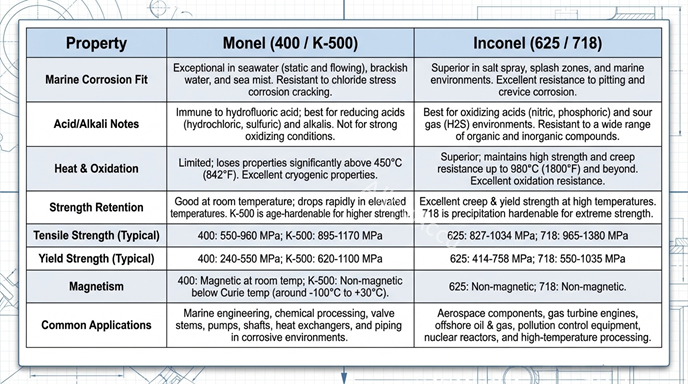
Technical Comparison: Inconel vs Monel
| Property | Monel (400 / K-500) | Inconel (625 / 718) |
|---|---|---|
| Marine Corrosion Fit | Exceptional in seawater (static and flowing). | Superior in salt spray and splash zones. |
| Acid/Alkali Notes | Immune to hydrofluoric; best for reducing acids. | Best for oxidizing acids and sour gas (H2S). |
| Heat & Oxidation | Limited; loses properties above 450°C. | Superior; maintains strength up to 980°C. |
| Strength Retention | Good at room temp; drops rapidly in heat. | Excellent creep & yield strength at temp. |
| Machining Behavior | Difficult (Sticky/Gummy); heat buildup risk. | Extreme (Work hardening); tool wear heavy. |
| Welding Notes | Good weldability; requires matching Ni-Cu filler. | Excellent; precise heat input control mandatory. |
| Typical Parts | Pump shafts, propellers, heat exchangers. | Fasteners, exhaust components, rocket motors. |
| Availability | Standard for marine industry. | Specialty alloy; high lead-time risk. |
Welding & Assembly Notes
Both Monel and Inconel require specialized welding protocols to ensure the joint integrity matches the parent metal’s corrosion resistance. At AlloyAccu, we provide full support for assembly projects.
Thermal Distortion Management
“Monel is prone to warping due to high thermal expansion. We provide precision jigging and sequenced welding to maintain tight tolerances.”
Filler Metal Compatibility
“Mismatching filler in marine environments leads to galvanic corrosion at the weld. We stock certified Ni-Cu (Monel) and Ni-Cr-Mo (Inconel) fillers.”
NDT Inspection (Available)
“We support Liquid Penetrant Testing (LPI) and X-ray inspection to ensure zero porosity in critical pressure vessel or subsea assemblies.”
Machining & Fabrication Reality
“Transitioning from stainless to Nickel alloys isn’t just about the material cost—it’s about the fabrication strategy.”
-
Gummy Machining (Monel)
We use razor-sharp geometry and specific rake angles to prevent ‘smearing’ on Monel valve stems.
-
Work Hardening (Inconel)
Rigid setups and high-torque spindles prevent tool chatter and instant hardening of the cut zone.
-
Surface Finishing
Passivation and precision grinding available to maximize pitting resistance in salt spray zones.
Common Mistakes to Avoid
“Prevent costly failures in marine and chemical projects.”
Using Monel for High-Heat Exhaust
While Monel is a “premium” metal, it loses mechanical properties rapidly above 450°C. For exhaust headers or flare tips, Inconel 625 is the only safe choice.
Underestimating Bio-Fouling
In stagnant seawater, bio-growth can trap acids against the metal. Monel has natural anti-fouling properties that Inconel lacks, making it superior for submerged shafts.
Mismatching Fasteners
Using stainless fasteners on Monel hulls causes rapid galvanic corrosion. We provide matching Monel K-500 or Inconel 718 fasteners to maintain electrical compatibility.
Ignoring “Alpha Case” in Machining
Incorrect tool cooling during Nickel machining can leave a brittle surface layer. Our low-stress grinding ensures long fatigue life for rotating marine parts.
Expert Q&A: Inconel vs Monel
Which is better for deep-sea subsea housings?
Can Monel handle Hydrofluoric (HF) Acid?
Why is Inconel more expensive to machine?
Is Monel magnetic?
Can you weld Monel to Stainless Steel?
How do I get a quote from AlloyAccu?
Launch Your Project
“Precision fabrication in Monel and Inconel requires more than just machines—it requires a deep understanding of metallurgy.”
Technical Quote Request
All materials provided with Mill Test Reports (MTRs).
Error: Contact form not found.