
Inconel vs Titanium:
The Ultimate Engineering Trade-off
Choosing between the ultimate heat resistance of Nickel Superalloys and the extreme strength-to-weight ratio of Titanium. Which alloy wins your specific application?
The 4-Dimensional Trade-off Map
Visualizing the core differences between Nickel Superalloys and Titanium Alloys across critical performance metrics.
Why the Trade-off?
- Inconel relies on Nickel-Chromium-Molybdenum matrix for creep resistance and oxidation barrier at glowing-red temperatures.
- Titanium offers the highest strength-to-weight ratio of any structural metal but loses significant strength above 400°C due to rapid oxygen absorption.
- Decision Rule: If the component temperature exceeds 500°C, Inconel is mandatory. Below 400°C, Titanium usually offers superior system-level efficiency.
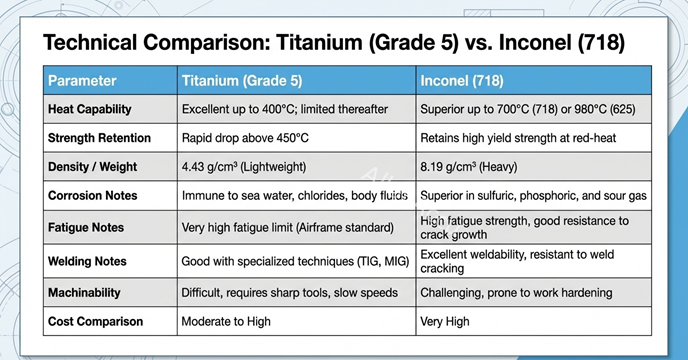
Technical Data Comparison
Head-to-head metrics for Titanium (Gr. 5) vs. Inconel (718/625)
| Parameter | Titanium (Grade 5) | Inconel (718) |
|---|---|---|
| Heat Capability | Excellent up to 400°C; limited thereafter. | Superior up to 700°C (718) or 980°C (625). |
| Strength Retention | Rapid drop above 450°C. | Retains high yield strength at red-heat. |
| Density / Weight | 4.43 g/cm³ (Lightweight) | 8.19 g/cm³ (Heavy) |
| Corrosion Notes | Immune to sea water, chlorides, body fluids. | Superior in sulfuric, phosphoric, and sour gas. |
| Fatigue Notes | Very high fatigue limit (Airframe standard). | High low-cycle fatigue resistance at temp. |
| Machining Cost | High (Heat buildup, galling). | Extreme (Work hardening, tool wear). |
| Welding Notes | Requires inert gas (Argon) shielding to prevent brittleness. | Excellent weldability; 718 avoids strain-age cracking. |
| Typical Applications | Airframes, Implants, Subsea Housings. | Turbine Blades, Rocket Engines, Flare Stacks. |
Machining Reality: Risks & Solutions
Both materials are classified as “Difficult-to-Cut” (DTC). However, the failure modes in the machine shop differ drastically. Understanding these is key to cost-effective procurement.
Titanium Challenge: Thermal Conductivity
Heat doesn’t dissipate through the chip; it concentrates at the tool tip, causing rapid oxidation and “galling” (material sticking to the tool).
Our Solution: High-pressure coolant & specialized geometry to minimize chip-tool contact time.
Inconel Challenge: Rapid Work Hardening
The surface hardens instantly under the tool path. If the cut isn’t deep enough, the tool rubs and fails within seconds.
Our Solution: Heavy-duty rigid setups, ceramic tooling for roughing, and “never-stop” feed strategies.
Surface Integrity
We utilize low-stress grinding and specialized finishing to eliminate residual stress in Titanium aerospace parts.
Stress Relief
Post-machining vacuum heat treatment for Inconel components to ensure dimensional stability in service.
Tooling Strategy
Custom PCD and Carbide tooling optimized for the specific grain structure of forged vs cast superalloys.
QA Protocol
Non-destructive testing (FPI/MPI) to verify no surface micro-cracking occurred during heavy machining.
Application Fit Matrix
Where each material dominates based on industry-specific conditions.
Aerospace & Defense
- Titanium: Landing gear, wing spars, engine fan blades.
- Inconel: Combustion liners, turbine discs, exhaust nozzles.
Marine & Subsea
- Titanium: Deep-sea housings, salt-water fasteners, hulls.
- Inconel: High-pressure valves, sour gas piping, subsea manifolds.
Chemical & Power
- Titanium: Desalination plants, pharmaceutical reactors.
- Inconel: Nuclear steam generators, waste incineration, furnaces.
Decision Validation Checklist
Does the continuous operating temperature exceed 450°C (842°F)? If yes, Choose Inconel.
Is every gram of weight reduction critical for performance/cost? If yes, Choose Titanium.
Will the part be exposed to highly concentrated chlorides or seawater? Titanium is often more cost-effective.
Is the component subject to severe oxidation or sulfur-bearing gases? Inconel provides better surface life.
“Correct material selection at the design phase saves 40-60% in lifecycle costs.”
Submit My Selection for ReviewExpert Q&A: Inconel vs Titanium
Is Inconel stronger than Titanium?
Which is harder to CNC machine?
Can Titanium be used for engine exhaust?
What are the cost implications?
Are there welding risks?
Can you machine both materials in-house?
Start Your High-Performance Project
Whether you need CNC machining, sheet metal fabrication, or 3D printing in Inconel or Titanium, our engineering team is ready to assist with DFM and competitive pricing.
Email Our Engineers
sales@alloyaccu.com
Global Manufacturing Hub
3rd Floor, Building C, Quanyongyuan Industrial Zone, Dalang Street, Longhua District, Shenzhen, China
Request a Technical Quote
Average response time: 4-6 business hours.
Error: Contact form not found.