
Inconel vs Stainless Steel:
The True Cost of Material Selection
Is switching to Stainless Steel a smart saving or a high-stakes gamble? Understand the engineering boundaries where 316 or 17-4 PH fail and Inconel thrives.
Critical Warning
“Many procurement teams focus on material unit price (USD/kg) while ignoring the 10x multiplier of unplanned downtime caused by premature stress corrosion cracking (SCC).”
AlloyAccu provides end-to-end fabrication for both Stainless Steel families (304, 316, 321, 347, 17-4 PH) and Nickel Superalloys. We help you choose the material that balances performance with project budget.
Technical Divergence: Stainless vs. Inconel
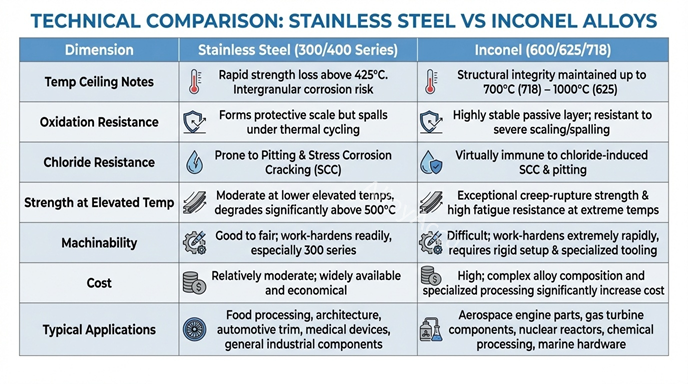
| Dimension | Stainless Steel (300/400 Series) | Inconel (600/625/718) |
|---|---|---|
| Temp Ceiling Notes | Rapid strength loss above 425°C. Intergranular corrosion risk. | Structural integrity maintained up to 700°C (718) – 1000°C (625). |
| Oxidation Resistance | Forms protective scale but spalls under thermal cycling. | Highly stable passive layer; resistant to severe scaling/spalling. |
| Chloride Resistance | Prone to Pitting & Stress Corrosion Cracking (SCC). | Virtually immune to chloride-induced SCC. |
| Creep Resistance | Poor; deforms permanently under load at temp. | Engineered specifically for high-stress creep resistance. |
| Welding Risks | Sensitization in 304/316; requires L-grades or stabilizers. | Excellent weldability; requires heat input control to avoid micro-fissuring. |
| Availability | Commodity availability; short lead times. | Specialty alloy; limited supply chains; longer lead times. |
| Machining Costs | Standard DTC strategies; manageable tool life. | Extreme tool wear; requires low speeds/high feeds; specialized setups. |
Myth vs. Reality
“Correcting common misconceptions in material substitution.”
“316L is sufficient for any corrosion-heavy environment.”
In hot chloride environments (>60°C), 316L is highly vulnerable to Stress Corrosion Cracking (SCC). Inconel 625 is required when failure would lead to catastrophic system downtime or safety risks.
“I can use 347/321 stainless for all engine exhaust parts.”
While stabilized stainless handles heat better than 304, it cannot withstand the low-cycle fatigue and oxidation of modern high-output turbo exhausts. Inconel 625 or 718 prevents “burning through” the manifold walls.
The Lifecycle Cost Multiplier
When procurement looks only at the invoice price of raw material, they miss the Total Cost of Ownership (TCO). Choosing Stainless where Inconel is needed often results in a “False Economy.”
Maintenance Labor
Inconel components often outlast Stainless counterparts by 4:1 in corrosive service.
Downtime Risk
A $500 Stainless bolt failing in a $1M turbine can cost $50k/day in lost production.
Refurbishment
Inconel parts can often be weld-repaired and reused; Stainless often requires total replacement.
Warranty Liability
Using Stainless in borderline conditions increases OEM product liability and recall risks.
Engineering Recommendation
“If your component is deep-sea, buried in a furnace, or inside a high-pressure reactor, the cost of access (excavation, vessel opening) far outweighs the material premium of Inconel.”
Case Study Pattern:
Chemical plant switched from 316SS valves to Inconel 625. Initial cost was 3x higher, but the plant eliminated a $120k bi-annual replacement cycle. ROI achieved in 14 months.
Replacement Risk Checklist
“Before substituting Inconel with Stainless Steel, you MUST verify these 5 engineering checkpoints.”
Temperature Peaks
Will the component EVER exceed 450°C during cleaning, surges, or startup? If yes, Stainless risks catastrophic creep.
Thermal Cycling Frequency
Does the part heat up and cool down daily? Stainless scale will spall and thin the walls; Inconel layer stays intact.
Media Concentration
Are chlorides, sulfides, or fluorides present at any stage? Pitting in Stainless is unpredictable and rapid.
Post-Weld Processing
Can you perform full solution annealing after welding? If not, HAZ corrosion in Stainless is a massive risk.
NDT & Validation Requirements
Is X-ray or ultrasonic inspection mandatory? Substituting materials may void your pressure vessel or aerospace certification.
Expert FAQ: Inconel vs Stainless Steel
Is Inconel just a better version of Stainless Steel?
Can I use 17-4 PH instead of Inconel 718 for strength?
Which is more cost-effective for CNC machining?
How do I prevent “Sensitization” when welding Stainless?
Is lead time a major factor in selection?
Does AlloyAccu provide material certification?
Optimize Your Build
Whether you are sticking with Stainless or upgrading to Inconel, our manufacturing experts will ensure your parts are delivered to spec, on time, and within budget.
Get a Manufacturing Quote
Error: Contact form not found.