
Inconel vs Incoloy:
Family Overview & Selection
Names that sound identical, but performance boundaries that aren’t. Choosing between these two Special Metals families is a balance of high-temperature strength and total project budget.
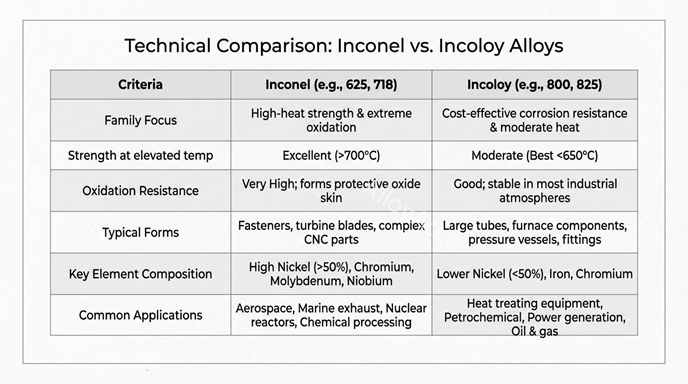
Family Overview: The Nickel-Iron Divide
The Inconel Family
Nickel-Chromium base. These are the “Heavy Lifters” of high-heat environments. With nickel content often exceeding 50%, Inconel is designed for extreme oxidation and strength above 700°C.
The Incoloy Family
Nickel-Iron-Chromium base. These are the “Industrial Workhorses”. By increasing iron content and reducing nickel, Incoloy offers significant cost savings while providing excellent service in moderate heat (up to 600°C).
Technical Performance Comparison
| Criteria | Inconel (e.g., 625, 718) | Incoloy (e.g., 800, 825) |
|---|---|---|
| Family Focus | High-heat strength & extreme oxidation. | Cost-effective corrosion resistance & moderate heat. |
| Strength at elevated temp | Excellent (>700°C) | Moderate (Best <650°C) |
| Oxidation Resistance | Very High; forms protective oxide skin. | Good; stable in most industrial atmospheres. |
| Typical Forms | Fasteners, turbine blades, complex CNC parts. | Large tubes, furnace components, pressure vessels. |
| Machining/Welding | High work hardening; requires rigid setup. | Better machinability; standard Ni-Fe-Cr weld protocols. |
| Cost/Availability | Premium; widely available in aerospace sizes. | Economical; readily available in piping/tubing. |
Performance vs Budget Slider
Visualizing the transition from industrial utility to aerospace performance.
Tubing & Shells
Large surface areas often favor Incoloy to manage total project costs without sacrificing durability.
Critical Supports
Where creep-rupture strength is non-negotiable, Inconel is the mandatory standard.
Precision Machining
We provide specialized tooling for both; Inconel requires slower speeds and higher rigidity.
Avoid Wrong-Spec Risk
Specifying Incoloy where Inconel is required (or vice versa) can lead to catastrophic failure or unnecessary budget bloat.
Common Consequences
-
Early Oxidation: Incoloy may scale prematurely at temperatures above its rated threshold.
-
Unexpected Distortion: Creep deformation in structural furnace parts under heavy load.
-
Budget Overrun: Using Inconel for simple acid-transfer piping where Incoloy 825 is superior.
Prevention & Verification
-
Operating Temp Check: Always verify peak vs. continuous operating temperatures.
-
Stress Analysis: Confirm if the part is load-bearing or purely a containment shell.
-
Speak to our DFM team: We review your drawings for material-to-application fit.
Ordering Tips: Precision RFQ Checklist
Exact Alloy Grade
Specify the numeric code (e.g., 625, 718, 800H, 825) as “Inconel” alone is a family name.
Material Condition
Annealed, Solution Treated, or Age Hardened? This impacts both performance and machinability.
Critical Tolerances
High-nickel alloys move during machining. Define where +/- 0.01mm is truly necessary.
Testing & Certs
Do you require MTRs (3.1/3.2), LPI (Dye Pen), or custom ultrasonic testing?
Material Selection FAQ
Is Incoloy cheaper than Inconel?
Generally, yes. Incoloy has higher iron content and lower nickel content, making it significantly more cost-effective for large-scale industrial components where extreme aerospace strength isn’t required.
Can you weld Incoloy to Inconel?
Yes. They are often joined in transition zones of furnace systems. We typically use high-nickel fillers like Inconel 625 to ensure the weld joint matches the heat resistance of the more robust material.
Which alloy is better for heat exchangers?
Incoloy 825 is a global standard for heat exchangers due to its excellent balance of acid resistance (sulfuric/phosphoric) and price, especially in shell-and-tube configurations.
Does Inconel have better oxidation resistance?
Yes. Inconel alloys form a more stable, tenacious protective oxide layer at temperatures above 700°C, making them superior for engine parts and exhaust components.
What are the most common Incoloy grades?
Incoloy 800 (for high-temp strength), 800H/HT (for creep resistance), and 825 (for chemical corrosion resistance) are the most frequently requested in industrial fabrication.
Is machining Incoloy easier than Inconel?
Slightly. The higher iron content makes Incoloy marginally less abrasive on tools, but it still requires the same rigid setups and positive-feed machining strategies as all high-nickel alloys.
Get Expert Machining Advice
From complex Inconel 718 aerospace components to large-scale Incoloy 800H industrial manifolds, we provide the technical precision and material traceability your project requires.
Direct Engineering Contact
sales@alloyaccu.comFacility Address
3rd Floor, Building C, Quanyongyuan Industrial Zone,
Dalang Street, Longhua District, Shenzhen, China