
Inconel vs Hastelloy:
Corrosion vs High Heat
Engineers often mistake these superalloys as interchangeable. One thrives in the fire of oxidation; the other survives the bite of aggressive acids. We help you define the boundary between heat resistance and chemical stability.
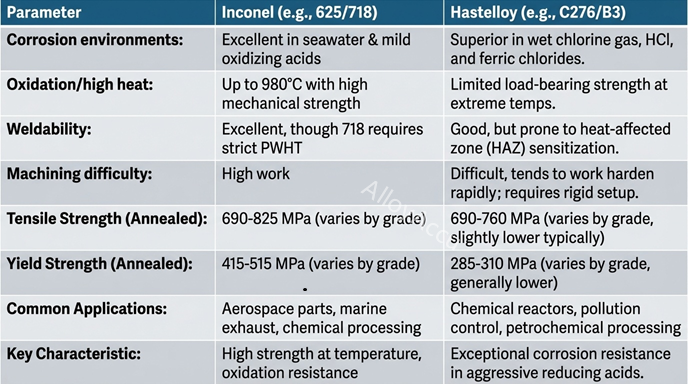
The Critical Decision Path
When choosing between nickel-chromium (Inconel) and nickel-molybdenum (Hastelloy), the environment dictates the metallurgy. It is not just about price; it is about failure modes.
-
Inconel: Prioritizes high-temperature oxidation resistance and creep-rupture strength.
-
Hastelloy: Prioritizes resistance to severe corrosion, particularly reducing acids and pitting.
Metallurgical Reality
“If your process involves Sulfuric or Hydrochloric acid at concentration, Hastelloy C276 is the baseline. If your process involves 800°C+ oxidation in a gas turbine or exhaust, Inconel 625 or 718 is the mandatory choice. Mixing these priorities leads to premature SCC (Stress Corrosion Cracking) or thermal fatigue.”
Corrosion vs Heat Selection Matrix
A high-level tendency map based on environmental severity. Use this as your first filter for material grade selection.
| Operational Environment | Inconel Preference | Hastelloy Preference | Primary Risk Factor |
|---|---|---|---|
| Oxidizing High Heat (>700°C) | VERY HIGH | MODERATE | Thermal Oxidation & Creep |
| Reducing Acids (HCl, H2SO4) | LOW | VERY HIGH | Rapid Uniform Corrosion |
| Chloride-Induced Pitting | HIGH (625) | VERY HIGH | Localized Pitting/Crevice |
| Cryogenic Conditions | HIGH | MODERATE | Toughness Retention |
Engineering Comparison Table
| Parameter | Inconel (e.g., 625/718) | Hastelloy (e.g., C276/B3) |
|---|---|---|
| Corrosion environments | Excellent in seawater & mild oxidizing acids. | Superior in wet chlorine gas, HCl, and ferric chlorides. |
| Oxidation/high heat | Up to 980°C with high mechanical strength. | Limited load-bearing strength at extreme temps. |
| Weldability | Excellent, though 718 requires strict PWHT. | Good, but prone to heat-affected zone (HAZ) sensitization. |
| Machining difficulty | High work-hardening rate; requires rigid setup. | Very high; extremely abrasive on tooling. |
| Typical supply forms | Bar, Plate, Wire, Forgings, Fasteners. | Sheet, Plate, Tubing, CNC Components. |
| Relative cost | High (Baseline). | Very High (Typically 20-40% more than Inconel). |
| Lead time risk | Moderate; commonly stocked in aerospace hubs. | Higher; project-specific mill runs common. |
| Main Alloy Element | Nickel-Chromium-Molybdenum-Niobium. | Nickel-Molybdenum-Chromium-Tungsten. |
DFM & Machining Notes
Tooling & Speed
Both materials require carbide or ceramic tooling. For Hastelloy, we reduce cutting speeds by 20% compared to Inconel to combat the abrasive molybdenum content. Positive rake angles are mandatory to “shear” the material rather than push it.
Heat Input Control
In welding, Hastelloy is sensitive to carbon pickup. We utilize low heat input and interpass temperature monitoring to prevent grain boundary precipitation, which destroys corrosion resistance.
Cold Work Hardening
Never “dwell” the tool. Inconel work-hardens instantly; if the tool rubs instead of cuts, the next pass will face a hardened skin that destroys the edge. Constant feed is critical.
Surface Finishing
For chemical applications (Hastelloy), we recommend electropolishing to ensure a passive oxide layer. For aerospace (Inconel), shot peening is often required to introduce compressive stress for fatigue resistance.
Traceability & Inspection
In critical environments, the material is only as good as its documentation. We provide full transparency to ensure your components meet industrial and aerospace standards.
MTR Support
Mill Test Reports (3.1/3.2) providing chemical heat analysis and mechanical properties.
Dimensional Reports
Full CMM or manual inspection reports ensuring tight tolerances on complex geometries.
NDT Services
Liquid Penetrant Inspection (LPI) and Ultrasonic testing available for structural integrity.
Surface Roughness
Measurement of Ra/Rz values to ensure compliance with fluid flow or sealing requirements.
Frequently Asked Questions
Can Hastelloy be used for high-temperature oxidation?
Yes, but it is not its primary strength. While Hastelloy C276 can withstand high temperatures, Inconel 600 or 625 offers better mechanical strength and creep resistance at temperatures exceeding 800°C.
Is Inconel 625 resistant to Hydrochloric Acid?
Inconel 625 has good resistance to many acids, but for concentrated Hydrochloric (HCl) or Sulfuric acid, Hastelloy C276 or B3 is significantly superior and less prone to rapid uniform attack.
Which alloy is more difficult to machine?
Hastelloy is generally considered more difficult due to its high molybdenum and tungsten content, which makes it extremely abrasive on cutting tools compared to most Inconel grades.
Are these materials magnetic?
Most common grades of both Inconel (625) and Hastelloy (C276) are non-magnetic in the annealed condition, which is critical for electronic and sensitive instrumentation applications.
Can you weld Inconel to Hastelloy?
Yes, they are metallurgically compatible. We typically use Hastelloy C276 or Inconel 625 filler metal for these joints, depending on which environment is more critical (corrosion vs. heat).
What is the cost difference between them?
Hastelloy is typically 20% to 50% more expensive than standard Inconel 625, largely due to higher molybdenum content and more complex raw material processing.
Start Your RFQ Today
Whether you need CNC machined Hastelloy manifolds or Inconel 718 aerospace fasteners, our team provides the technical precision your project demands.
Email Our Engineering Team
sales@alloyaccu.comHeadquarters
3rd Floor, Building C, Quanyongyuan Industrial Zone,
Dalang Street, Longhua District, Shenzhen, China