
Inconel 625 vs 718: The Engineer’s Guide to Material Selection
Deciding between these two superalloys for your next project? Understanding the trade-offs in strength, corrosion resistance, and machinability is critical for project success and cost control.
Typical Application Scenarios
Marine & Offshore
Propeller blades, submarine motor components, and heat exchangers where seawater corrosion is the primary threat. (Primarily 625)
Aerospace Engines
Turbine disks, blades, and combustion chambers requiring high strength at 1300°F. (Primarily 718)
Chemical Processing
Reaction vessels, distillation columns, and piping for highly acidic environments. (Primarily 625)
The Fundamental Distinction
While both are nickel-chromium-based superalloys, their hardening mechanisms define their applications. Inconel 625 is a solid-solution strengthened alloy (molybdenum and niobium in a nickel-chromium matrix), optimized for corrosion resistance and fatigue strength. Inconel 718 is a precipitation-hardened (age-hardened) alloy, designed for extreme tensile and creep-rupture strength at elevated temperatures.
- 625: Superior in marine and chemical processing.
- 718: Dominant in aerospace and high-stress components.
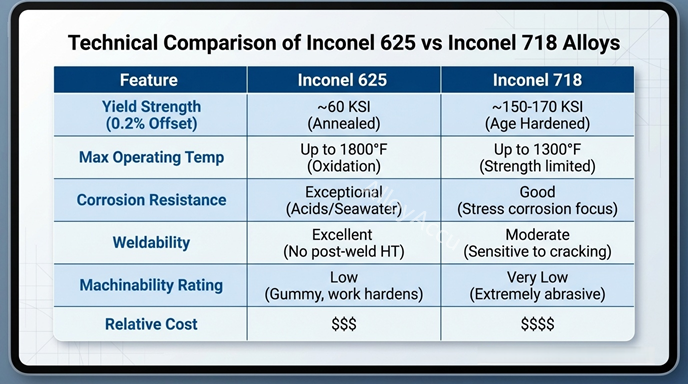
Technical Specifications Comparison
| Feature | Inconel 625 | Inconel 718 |
|---|---|---|
| Yield Strength (0.2% Offset) | ~60 KSI (Annealed) | ~150-170 KSI (Age Hardened) |
| Max Operating Temp | Up to 1800°F (Oxidation) | Up to 1300°F (Strength limited) |
| Corrosion Resistance | Exceptional (Acids/Seawater) | Good (Stress corrosion focus) |
| Weldability | Excellent (No post-weld HT) | Moderate (Sensitive to cracking) |
| Machinability Rating | Low (Gummy, work hardens) | Very Low (Extremely abrasive) |
| Relative Cost | $$$ | $$$$ |
| Lead Time Risk | Low (Good stock) | Moderate (High demand) |
Quick Decision Selector
Choose Inconel 625 If…
- Your part is exposed to salt water or aggressive chemicals.
- You require high fatigue strength in non-structural parts.
- Complex welding is required without subsequent heat treatment.
- Service temperatures will exceed 1400°F consistently.
Choose Inconel 718 If…
- High tensile, yield, and creep-rupture strength are mandatory.
- The application is structural (engine parts, fasteners).
- You are operating in the range of -400°F to 1300°F.
- Weight-to-strength ratio is a primary design driver.
DFM & Machining Strategy for Engineers
Tooling & Wear
Both alloys cause rapid tool wear due to their abrasive nature. For 718, we recommend ceramic or carbide tools with positive rake angles. Inconel 625 is “gummier,” requiring sharp edges to prevent material buildup (BUE).
Coolant & Hardening
These materials work-harden instantly. Use heavy-duty, sulfurized lubricants or high-pressure coolant systems. Never let the tool dwell on the surface, as it will create a hardened skin that ruins subsequent passes.
Heat Treatment Impact
718 is typically machined in the solution-annealed state and then age-hardened to final specs. 625 is mostly used in the annealed condition. Be aware that age-hardening 718 causes slight volumetric changes.
Engineering Risk Alert
Welding Inconel 718 carries a high risk of strain-age cracking during post-weld heat treatment. If your design requires heavy welding on complex sections, Inconel 625 is the safer metallurgical choice unless structural loads dictate otherwise.
One-Stop Manufacturing for Superalloys
At AlloyAccu, we specialize in high-precision processing of Inconel 625 and 718.
CNC Machining
5-axis milling & precision turning
Sheet Metal
Laser cutting & precision bending
Welding
TIG, MIG & Laser welding
3D Printing
SLM / DMLS metal printing
Frequently Asked Questions
Which Inconel is better for salt water?
Inconel 625 is significantly better for marine environments due to its higher molybdenum content, which provides superior resistance to pitting and crevice corrosion compared to 718.
Can Inconel 718 be welded?
Yes, but it is more challenging than 625. It is prone to strain-age cracking during heat treatment. Precise control of the heating and cooling cycles is mandatory for successful 718 welds.
Why is Inconel 718 more expensive to machine?
718 has a higher work-hardening rate and is more abrasive on cutting tools. This leads to slower cutting speeds and more frequent tool changes, increasing the overall machining cost.
What is the main advantage of Inconel 718?
Its extreme yield strength (up to 3x that of 625) and its ability to maintain that strength at temperatures up to 1300°F (700°C).
Is 625 or 718 better for high-temperature oxidation?
Inconel 625 is generally preferred for pure oxidation resistance at the highest temperatures (up to 1800°F), whereas 718 is preferred when high strength is needed alongside oxidation resistance.
Which alloy has better lead time?
Generally, Inconel 625 has more stable availability. Inconel 718 often faces supply chain volatility due to its high demand in the aerospace and defense sectors.
Ready to Start?
Send us your technical drawings or project requirements. Our engineering team will review your selection and provide a DFM-optimized quote within 24 hours.
3rd Floor, Building C, Quanyongyuan Industrial Zone, Dalang Street, Longhua District, Shenzhen, China