
Inconel 600 vs 601: High-Temp Material Guide
Engineers and procurement teams often struggle between Alloy 600 and 601. While 600 is the standard for corrosion resistance and strength, 601 adds Aluminum for extreme oxidation resistance. Choose the wrong one, and you risk premature thermal failure or unnecessary material costs.
Ni-Cr alloy with excellent resistance to chloride-ion stress-corrosion cracking and caustic corrosion.
Ni-Cr-Al alloy designed specifically for resistance to oxidation and other forms of high-temperature corrosion.
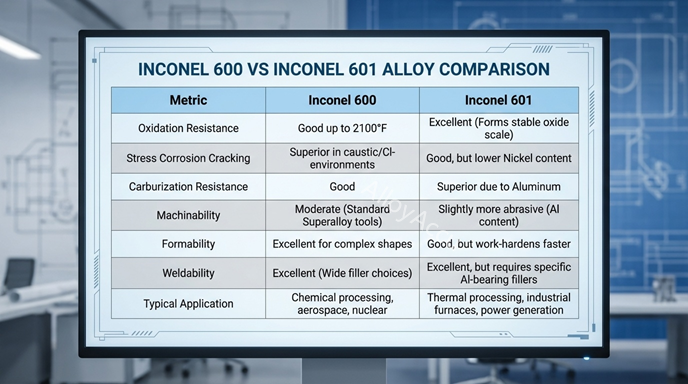
Side-by-Side Comparison
| Metric | Inconel 600 | Inconel 601 |
|---|---|---|
| Oxidation Resistance | Good up to 2100°F | Excellent (Forms stable oxide scale) |
| Stress Corrosion Cracking | Superior in caustic/Cl- environments | Good, but lower Nickel content |
| Carburization Resistance | Good | Superior due to Aluminum |
| Machinability | Moderate (Standard Superalloy tools) | Slightly more abrasive (Al content) |
| Formability | Excellent for complex shapes | Good, but work-hardens faster |
| Weldability | Excellent (Wide filler choice) | Good (Requires 601 filler for temp) |
| Cost & Lead Time | Lower cost / Better availability | Higher cost / Specific sourcing |
Decision Tree: Finding Your Alloy
Follow these checkpoints to determine the most cost-effective solution for your application.
Temp Range
>2100°F? Head to 601. <2000°F? 600 is viable.
Oxidation
Cycling heat? 601’s oxide scale is more stable.
Environment
Caustic or Chloride? 600 wins on corrosion resistance.
Fabrication
Extreme bending? 600 is slightly more ductile.
Final Quote
Ready for DFM? Click the CTA below.
Failure Modes & Selection Risks
Spalling (Scale Loss)
In thermal cycling, Inconel 600 can lose its protective oxide layer, leading to rapid thinning. Avoid this by selecting 601 for applications with rapid heat/cool cycles.
Carburization Failure
In furnace environments, carbon can penetrate the grain boundaries. 601’s Aluminum content creates a barrier that 600 lacks. Tip: Use 601 for radiant tubes and retorts.
Weld Cracking
Selecting the wrong filler metal for 601 (like using 625 filler for 2000°F service) causes catastrophic joint failure. Verification: Always match filler to service temperature, not just base alloy.
Optimized Manufacturing Route
CNC Machining Logic
Best for shafts, fasteners, and sensor housings. Use rigid setups and carbide tooling with positive rakes to minimize work-hardening in both 600 and 601.
Laser Cutting & Bending
Ideal for furnace muffles and baskets. 601 is stiffer; ensure minimum bend radii are 3x thickness to prevent micro-cracking during cold forming.
Welded Fabrications
Complex furnace internals. We provide X-ray and dye-penetrant testing to ensure weld integrity in high-stress thermal zones.
Full-Spectrum Superalloy Capabilities
Whether you need 5-axis CNC machining, precision sheet metal fabrication, or 3D printed nickel components, our Shenzhen facility is equipped to handle the complexities of Inconel 600 and 601.
Technical FAQ: Alloy 600 vs 601
Is Inconel 601 magnetic?
Can I use 600 filler for a 601 joint?
Why is 601 more expensive than 600?
Which alloy is better for ammonia environments?
What is the main benefit of Aluminum in 601?
Are these alloys available in 3D printing?
Secure Your Project Integrity
Don’t leave material selection to chance. Our engineering team provides free DFM reviews to ensure your Inconel components are optimized for both performance and manufacturing cost.
3rd Floor, Building C, Quanyongyuan Industrial Zone, Dalang Street, Longhua District, Shenzhen, China